

home
 services
data validation
nanostring nCounter™ system
services
data validation
nanostring nCounter™ system
|
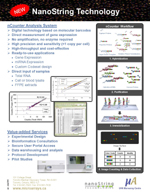
NanoString's nCounter™ Analysis System (developed by NanoString Technologies) utilizes a digital technology
based on direct multiplexed measurement of different types of target molecules (mRNA, miRNA or DNA) using
fluorescent barcodes that bind to these targets. The nCounter™ Analysis System measures RNA abundance by
tagging with barcodes and counting individual mRNA molecules using a novel digital technology. For sensitivity,
this system is able to detect 1 copy of mRNA per cell, can evaluate up to 800 genes per reaction, and requires
only 10-100 ng of total RNA for analysis.
|
|
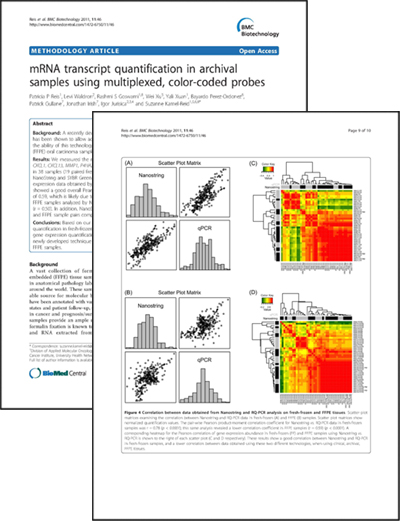
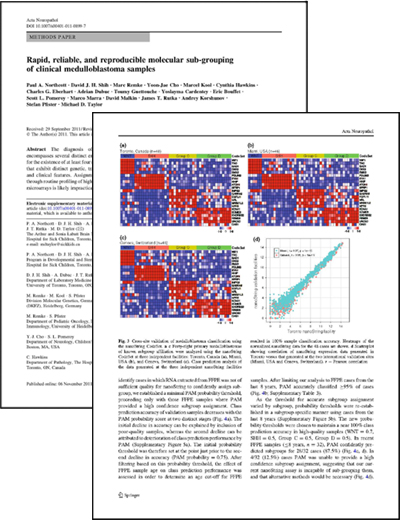
The UHN Microarray Centre has successfully assisted the scientific community in obtaining reproducible gene expression data from
FFPE samples using the NanoString platform.
Reis PP, et.al., mRNA transcript quantification in archival samples using multiplexed, color-coded probes.
BMC Biotechnol 2011, 11(1):46.
and
Northcott PA, et.al., Rapid, reliable, and reproducible molecular sub-grouping of clinical medulloblastoma samples.
Acta Neuropathol 2011, Nov 6, epub.
How it works:
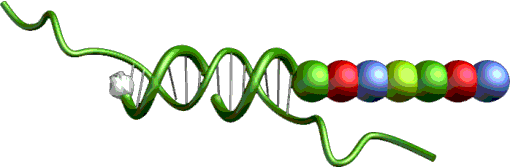
Each gene of interest (target sequence) has a corresponding capture probe and reporter probe. In addition to a
sequence that is complementary to the target sequence, the capture probe has a biotin molecule attached (used to
immobilize the sample) and the reporter probe carries a unique fluorescent barcode for detection. The reporter
probes and capture probes for all genes of interest, collectively known as the CodeSet, are then hybridised to
the sample. After the capture and reporter probes are bound to the mRNA, a stable tripartite structure is formed
and linked to a streptavidin-coated cartridge (via the biotin capture probe) and aligned electrophoretically.
The barcodes are then counted and tabulated. The Digital Analyzer uses an epi-fluorescent microscope and a CCD
camera to collect image data which is converted to a digital signal. Brightness of the code does not carry any
information, it is simply present or not present. The data output is simply the gene name, accession number and
number of times that transcript was counted in that sample.
|
|
|
Please click here for links to publications using Nanostring technology.
Gene Expression Analysis
nCounter™ Gene Expression Panels (CodeSets), nCounter™ Virtual Gene Sets, and nCounter™ Custom CodeSets are
available from Nanostring Technologies.
Gene Expression Panels (CodeSets):
- nCounter GX Human Kinase (519 genes)
- nCounter GX Human GPCR (431 genes)
- nCounter Human Cancer Reference (230 genes)
- nCounter Human Inflammation (184 genes)
- nCounter Mouse Inflammation (179 genes)
- nCounter Human Reference GX (18 genes)
- nCounter Customer Assay Evaluation (CAE) kit (48 genes)
- Angiogenesis (185 genes)
- Apoptosis (166 genes)
- Breast Cancer-Estrogen Receptor (202 genes)
- Cell Cycle (189 genes)
- Jak-Stat pathway (92 genes)
- p53 pathway (108 genes)
- Stem Cell (199 genes)
- Wnt Signalling Pathway (102 genes)
- Mouse Cancer Reference (238 genes)
- Mouse Stem Cell (194 genes)
miRNA Expression Assay Kits
- NEW! Human v2 miRNA Expression Assay Kit contains >800 human miRNAs derived from miRBase (Release 18.0).
- Human miRNA Expression Assay Kit contains >700 human and human-associated viral miRNAs derived from miRBase (Release 14.0).
- Mouse miRNA Expression Assay Kit contains >600 mouse and mouse-associated viral miRNAs derived from miRBase (Release 15.0).
- Rat miRNA Expression Assay Kit contains >400 rat miRNAs derived from miRBase (Release 17.0).
- NEW! Drosophila miRNA Expression Assay Kit contains >183 Drosophila miRNAs derived from miRBase (Release 18.0).
NEW! Custom Copy Number Variation CodeSets allows multiplexing up to 800 regions in a single reaction.
Pricing:
nCounter™ Catalogue Gene Expression Panels, miRNA Assays and Virtual Gene Sets
Download
 (last updated: May 2012)
nCounter™ Custom CodeSet
Download (last updated: July 2011)
Please note that this pricing is for academic groups.
Commercial customers, please inquire.
Contact: NanoString Service at
Please note that special paperwork is required for shipping RNA from
locations outside of Canada. For the Customs documentation that you will need, please download this
form .
Once you send us this information, the UHN Customs Officer will generate the appropriate Customs document
and send it to you via e-mail. This document must be included with the waybill on your package.
Quick questions:
 Expand all
 Hide all
- What is digital detection?
-
Digital detection uses discrete units for measurement, in contrast to analogue detection, which uses the relative levels of signal (such as fluorescence) for detection and quantification. In the case of the nCounter system, the identification of each transcript depends only on the order of the fluors on the string (barcode) and not on the intensities of the fluors. The number of transcripts in a sample is quantified by counting the number of times a particular barcode is detected.
- What constitutes an assay?
An assay is a single sample. This could be a unique sample, or one of several replicates.
- How much total RNA is required per assay?
A minimum of 100ng of total RNA or a lysate of 10,000 cells. Total RNA, including RNA from FFPE samples, should meet minimal integrity requirements (more than 50% greater than 300bp) in order to obtain good results.
- What if my RNA samples are slightly degraded?
-
It depends on how degraded the sample is. Good results can be obtained if more than 50% of the sample is greater than 300bp. Each of the two gene-specific probes are between 35-50 bases (70-100 consecutive bases needed just for probes to hybridise).
- What is a CodeSet?
Each unique mRNA sequence has its own pair of reporter and capture probes. The CodeSet is the collection of all reporter probes and capture probes for all genes of interest in an assay. Off-the-shelf CodeSets (nCounter Gene Expression Panels) are available from NanoString Technologies, including the Human Kinase CodeSet and Human GPCR CodeSet. nCounter Custom CodeSets can also be made with your specific genes of interest.
- Are there control samples in the CodeSets?
-
The nCounter CodeSets include positive control codes and synthetic RNA targets that have been spiked in to the CodeSets at concentrations ranging from 0.1fM -100fM which roughly correspond to 0.2-200 copies per cell of mRNA.
- Are there controls built into a custom CodeSet?
Yes there are (see previous question), but it is also highly recommended to include 3-8 "housekeeping" genes (or reference genes specific to your samples) in the custom CodeSet.
- Can the Virtual Gene Sets be modified?
Yes, genes can be added to (or removed from) the Virtual Gene Sets. The number of genes added (or removed) will increase (or decrease) the cost of the CodeSet.
- What kind of "housekeeping" genes should be included?
Popular choices for "housekeeping" or reference genes would be actin or GAPDH, but it is dependent on the biological system being studied. Ideally, genes with steady (not changing) expression are recommended. At least three "housekeeping" genes should be included.
- What kinds of catalogue assays (gene expression panels) are available?
nCounter GX Human Kinase CodeSet (over 500 human kinase genes)
nCounter GX Human Kinase (519 genes)
nCounter GX Human GPCR (431 genes)
nCounter Human Cancer Reference (230 genes)
nCounter Human Inflammation (184 genes)
nCounter Mouse Inflammation (179 genes)
nCounter Human Reference GX (18 genes)
nCounter Customer Assay Evaluation (CAE) kit (48 human genes from MAQC study)
View more information- How is the nCounter™ data analysed?
The nCounter system provides a comma separated value file that can be imported and analysed in programs like Excel, Open Office, or Matlab. NanoString Technologies has provided guidelines for normalisation and data analysis. The nCounter Data Analysis Guidelines will provide more information.
- How long does it take to get results from one sample?
The entire assay takes 22 hours of one 12-sample cartridge (including the 16 hour -overnight hybridisation, two hours on the liquid-handling Prep Station, and four hours on the Digital Analyzer). The time to run the assay is independent of the number of genes analysed (the assay time is the same for a 20-plex assay and a 800-plex assay).
- Are there restrictions as to the number of assays?
Custom CodeSets are available in assay numbers of 48, 96, 192, and 384, and then multiples of 384.
- Are there restrictions as to the number of genes?
The minimum number of genes in an assay is 20 and the maximum can be as many as 800.
- How is the nCounter™ system quantitative, and how sensitive is it?
-
The nCounter system is able to detect, count and report molecules across all biological levels of expression. The nCounter CodeSets include positive control codes and synthetic RNA targets that have been spiked in to the CodeSet at concentrations ranging from 0.1fM -100fM which roughly correspond to 0.2-200 copies per cell of mRNA. Using these internal controls, users can plot a regression line and quantify relative levels of expression for each of the genes in the CodeSet. The sensitivity of the nCounter system is comparable to qPCR.